

.png?width=1920&height=1080&name=CRARS%2026%20Article%20Why%20are%20your%20climate%20risk%20assessments%20%26%20asset%20decisions%20flawed%20(3).png)
By Thomas Walmsley
Last updated: 23 June 2026
In the first half of the 2025–26 higher-risk weather season, the Federal Government committed over $459 million in extraordinary recovery assistance(*1) across five states and territories. This financial burden is part of a broader trend. The Insurance Council of Australia(*2) recently confirmed that extreme weather events cost almost $3.5 billion in insured losses throughout 2025.
For those managing physical assets, these figures demonstrate that climate risk ignores the boundaries of a balance sheet or the perimeter fence of an industrial site. A flood that compromises a regional rail line simultaneously severs mining supply chains, disrupts maintenance access for telecommunications providers, and forces insurers to re-evaluate the risk profile of every asset in the district.
The most effective resilience strategies are now being shaped by leaders who look for best practice beyond their own sectors. These practitioners are learning from how energy networks manage heat stress, how transport hubs model inundation, and how the financial sector is linking resilience investment to capital health(*3).
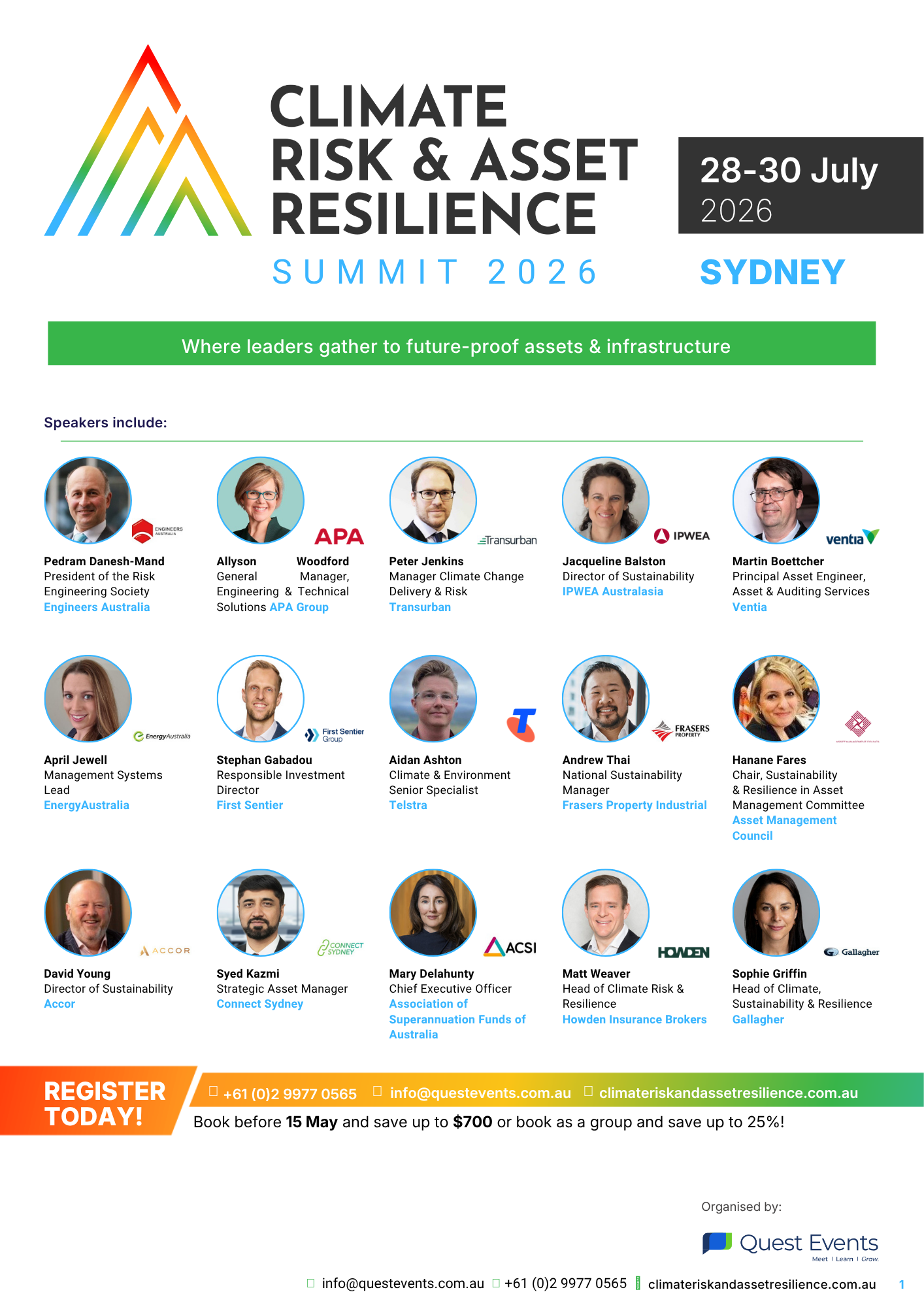
Ahead of the Climate Risk & Asset Resilience Summit 2026, Quest Events spoke with Kumar Srinivasan (Director, Risk & Insurance, University of Technology Sydney) and Martin Boettcher (Principal Asset Engineer, Asset and Auditing Services, Ventia Engineering Services) to gain their insights into the blind spots in climate planning and the value of aligning strategies across different sectors.
Identifying the shared blind spots
Kumar Srinivasan has observed that while industries use different technical language, the underlying exposures remain remarkably consistent. He argues that the greatest risk often lies in how organisations frame the problem.
“From my experience across Sydney Water, TfNSW, Sydney Metro and now UTS, the terminology of climate risk may differ, but the underlying exposures and cultural blind spots are strikingly similar. A drought does not just stress water supply; it affects hospital cooling, rail substations and data centres simultaneously. A flood does not just damage a road; it disrupts critical supply chains.”
Martin Boettcher adds that climate risk exposes how fragile our systems really are.
“Across industries, the biggest blind spots are common-mode failure and temporary loss of resilience. Organisations often assume they are protected because they have redundancy, without testing whether primary and backup systems share the same location, supply chain, climate exposure, or control systems. Risk also spikes during routine activities such as maintenance outages: the equivalent of a single freeway closure triggering network-wide congestion. Extreme events rarely fail assets in isolation; they exploit system dependencies and moments when redundancy quietly disappears."
Know your broader constraints
Boettcher deals with the engineering reality of protecting assets in a volatile environment. He suggests that the most robust plans are those that acknowledge the constraints of the broader system rather than just the individual asset.
"Stronger climate resilience plans emerge when different industries align around shared system constraints rather than optimising assets in isolation. This becomes especially effective when physical assets are planned alongside central coordination functions capable of handling multiple, overlapping events.
“During extreme scenarios, failures rarely arrive one at a time. Power disruption, access constraints, demand surges, and safety incidents compound. But where industries plan together, resilience shifts from isolated hardening measures to shared situational awareness, prioritised response and staged recovery sequences. The outcome is lower system-wide failure risk, particularly during high-impact events where independent plans would otherwise collide or compete.”
The danger of the "backyard" mentality
A common trap for asset owners is the belief that resilience can be achieved in isolation. Srinivasan warns that this ignores the reality of what he terms “asymmetric interdependency”.
“TfNSW can do everything right internally and still find its network non-operational because the roads that staff use are flooded, the grid serving a critical TfNSW operational precinct is overloaded, or TfNSW's emergency contractor has been hit by the same event.
“At UTS, we are located on the fringe of the Sydney CBD. Our resilience is tightly coupled with the city’s power, water, transport systems and surrounding institutions. A campus that remains physically intact but is surrounded by inundated streets and a non-operational rail network is not resilient. It is isolated.
“The risk I highlight is asymmetric interdependency. We have limited influence over whether the city’s grid holds during an extreme heat event. If it fails, every research lab, server room and welfare facility on campus is immediately impacted. That is a material exposure largely outside our control. The response is to actively engage with those dependencies, but most organisations have not yet done that work.”
Boettcher adds that this failure to look outward is often what ultimately leads to systemic collapse.
“Organisations naturally focus on what affects them directly. The real risk is not ignoring others; it’s failing to understand which external forces can materially impact their own survival. In practice, change rarely happens because of goodwill or awareness alone. Regulation sometimes forces action, but more often economics does the job faster and harder.
“Major shifts, from power generation to water security, occurred because new realities made existing approaches untenable. Businesses that treat climate risk as abstract miss this point. What catches them out are disruptive forces they assumed were someone else’s problem, until costs, reliability, or viability suddenly collapse.”
Cross-sector lessons from the Black Summer
The value of coordinated thinking is evident in major climate events. Srinivasan reflects on the 2019-20 bushfires as an example where individual capability was undermined by collective gaps.
“I was with TfNSW during the Black Summer bushfires. TfNSW, RFS, National Parks and local councils each had credible emergency plans. Individually, they performed well. But when overlaid, critical gaps emerged; evacuation routes that had not been tested against fire behaviour, and communication protocols that assumed power and mobile networks would remain operational.
“What this exposed is that resilience requires shared consequence-mapping, not just information-sharing. It is not enough to know what neighbouring organisations are doing; we must understand what their failure means for our systems, and vice versa. That is the conversation many organisations have yet to have.”
Gold standards
When looking for concrete solutions, both experts point to sectors that have been forced to innovate faster than others. For Srinivasan, the insurance industry provides a level of rigour in recovery costs that most asset owners lack.
“I believe asset insurers do it well. Others should copy their asset-level probabilistic modelling built into real decisions. Another concept worth borrowing is probable maximum loss: not just what might happen, but what would it actually cost to recover, end to end? Most organisations do scenario planning. Very few follow through to the recovery cost with any rigour.”
Boettcher looks to the energy sector, which has undergone a fundamental transformation in its operating modes due to the shift toward renewables.
"Every industry innovates when forced to; necessity remains the strongest driver of change. What distinguishes the power sector is the scale and speed of transformation driven by economics as well as climate risk. The shift from predictable, fossil-fuel baseload to weather-dependent solar and wind has forced a fundamental rethinking of grid stability, asset roles, and operating modes. Traditionally steady generators now cycle, ramp, and operate outside historic assumptions, while outage planning must align with volatile demand and price signals. This has embedded risk, resilience, and commercial impact into day-to-day decisions; a discipline other asset-intensive industries can learn from.”
True resilience is found at the intersection of industries
For heads of asset management, engineering, and risk, the ability to step outside of a sector-specific silo is a necessity for maintaining service continuity. With this understanding, asset owners can build strategies that are as interconnected as the risks they face.
Kumar Srinivasan and Martin Boettcher will be speaking at the Climate Risk & Asset Resilience Summit 2026. To see the full program and join the conversation across industries, visit the summit website here.
*1 - https://www.nema.gov.au/about-us/media-centre/2025-26-higher-risk-weather-season-lives-its-name
*2 - https://insurancecouncil.com.au/resource/extreme-weather-cost-3-5-billion-in-2025/
*3 - https://www.apra.gov.au/news-and-publications/mind-gap-insurance-climate-vulnerability-assessment